

Hardcore Redemption: 9 LIVES OF A WET PUSSY (1973)

Hardcore Redemption is an article attempting to redeem my favourite pornographic titles.
As of [starting] this, it was yesterday that a few people sat in a basement on a sweaty Wednesday afternoon to watch 50-year-old pornography by the living legend Abel Ferrara.
who
There's a reason this little period after the supposed Summer of Love, but in between the mainstream introduction of video, is called the 'Golden Age of Pornography'. This period saw a boom in narrative-driven, feature-length films that featured extensive unsimulated sex. Arguably, the Bohemian sensibilities of the decade bled into the underground film scenes of New York and L.A alike, and fuelled by mafia money, produced some of the most ambitious visual pornography to date.
So it's New York, mid-70s, Times Square is booming; a parade for all the sleazy pleasures of sex you can imagine. It's no surprise that a filmmaker from the underground scene gets together his ragtag bunch of friends in 1976 and shoots a porno, as it was the only way he could acquire funding and in turn, help shape an exciting new genre signalling the end of the Production Code era.
The cast was a patchwork of New York's underground: strippers, an unemployed school teacher, Ferrara's then-girlfriend (Pauline), a bunch of ambitious outsiders who all played their roles perfectly. Writer Nicholas St John also went on to collaborate on some of Ferrara's best films of the coming decades, alongside composer Joe Delia.
Many directors viewed hardcore as a means to an end: funded projects washed money for local crime families, and provided penniless, independent artists a way to make films. This illegal money gave amateurs headway to experiment with subject matter and the technical aspects of filmmaking. Wes Craven is another filmmaker who went on to garner acclaim, whose first feature was the adult film: The Fireworks Woman.
epistolary
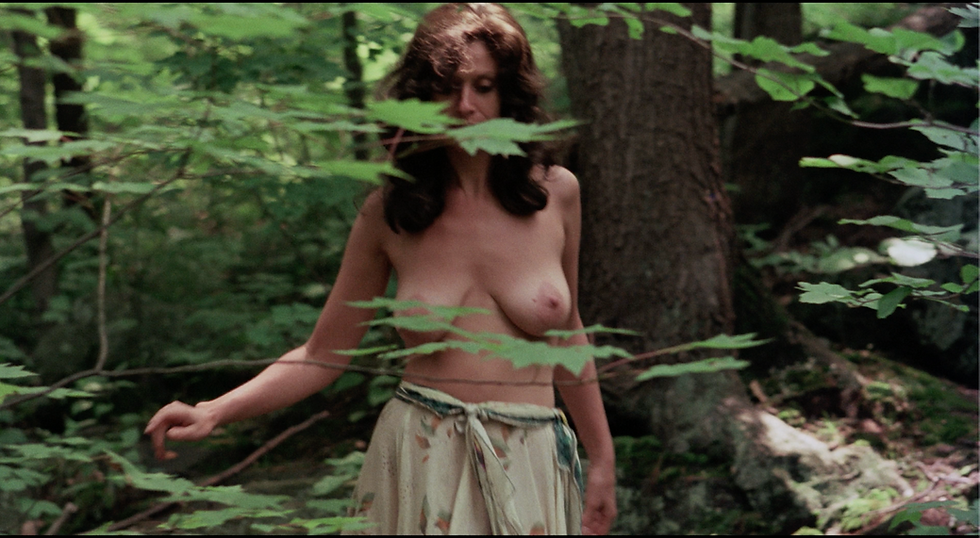
In 9 lives of a Wet Pussy, Ferrara presents a dreamy, non-linear account of the melding of fantasy and desire, traversing the textures of psychedelic encounters with nameless bodies only motivated by a lust which has conquered every modicum of reasoning.
Time and reality dissolve around the sexual imaginaries of Gypsy, a jealous witch who doesn't look much different to the witches of the modern day, surrounded by her tarot cards and black kitty cat. She pulls from her smoking opium pipe while reading letters from her lover, Pauline. Sinking further into her bed, Gypsy touches herself and remembers

Pauline in the arms of others.
9 Lives floats effortlessly between 'serious drama, pornographic cliché and blasphemous satire worthy of Bataille or Bunuel' [Brad Stevens] to fashion an arousing exploration of the infinite nature of desire: where a quest for continuity decimates the line between fantasy and reality.
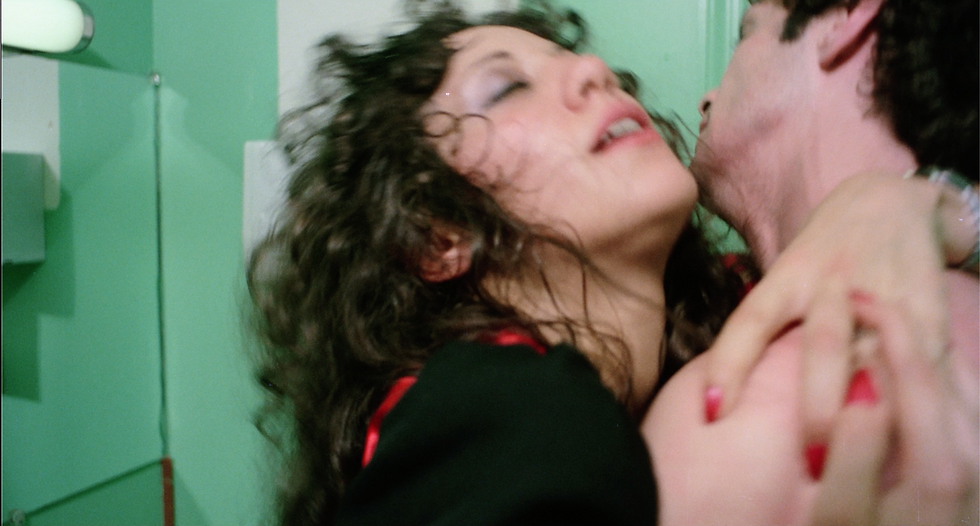
Gypsy's jealousy and possessiveness over Pauline are emphasised through monologued interludes. She illustrates quite a cliché for crazy lesbians! Subversely, the obsessive need to claim Pauline is at odds with the woman who appears in her fantasies; the one who seeks pleasure wherever she goes, embodying the 'eternal now' of French philosopher Georges Bataille's definition of Eroticism. Pauline constantly reaches towards continuity - the wholeness of the universe that all human sexuality is an attempt to rectify after our traumatic birth into discontinuous being, firstly enacted through her encounter with a lad who works in the petrol station, whom she mounts, then leaves breathless on the bathroom floor. The immediacy of their sex seems to override all the logic that reality has been based on post-Enlightenment, leaving no room for the grounding of rationale or thought of consequences. Each preceding encounter continues like this, in a haze of horniness and disembodied moans sprinkled into the hypnotic sound design. 9 Lives viscerally and unashamedly honours the sensual as a potent human drive that disrupts all sense of time.
"She's never known a jealous moment in her life. You see, being her lover today would never mean you would be her lover tomorrow. It's as if she didn't have a memory. Only the one in her arms is the one she desires. And because of this, to own her love was impossible. I wanted to own her, but she couldn't be owned."
exploitation
Pauline's relationship with another woman, one that appears way deeper than the encounters with men, provokes a magical intervention by Gypsy. In this vignette, we see a black woman called Nacala, said to be a Nigerian Princess, in the soft arms of Pauline. Later, when the women are sitting together, Nacala recalls the nightmares she's had since meeting Pauline, going on to recount her assault after the first time leaving her apartment [which Gypsy has already heavily implied was due to her magic]. We watch Nacala make her way through the streets of New York, eventually chased by two men into an apartment building. Falling on the stairs, the men grab her and begin to rip off her clothes. In the struggle, she manages to grab a broken bottle and slash his face, momentarily getting away before the second man catches up to her.
This scene takes the explicit framing of rape - constituting a key feature of sexploitation films - whilst remaining in the scope of the imaginary pornotopia in which most Hardcore films situate themselves, where rape is never really rape. Arguably, Ferrara doesn't depict sexual assault as something only meant to titillate here (one of many problematic aspects of the genre) like so many porno chic titles, but instead presents it as one of our most pressing political subjects - one that remains inevitable in an economic system that thrives off exploitation, appearing here distilled into its purest form - as the rape of women.
Great exploitation cinema is a psychic exorcism of the anxieties of living in hostile urban landscapes. I talked in my previous Hardcore Redemption article about Water Power and cinematic depictions of rape as a response to a decaying city rife with poverty and crime. There's a racial dimension to the rape depicted here, enacted by two black men on a black woman, which is a whole other discussion to be had, along with how rape was re-emerging in the public consciousness as something that strangers enact: someone in the shadows of a dark alleyway or empty stairwell, instead of someone who's known or is in an intimate relationship with the victim. In this context, the rape is also Gypsy's revenge; a violation in return for violating the sacred lesbian bond between her and Pauline. But like with a lot of what happens in the film, by the end of the sequence, it becomes unclear whether it happened or in fact, was all a bad dream.

Balancing opposing sensibilities - that of arthouse and that of sexploitation - Ferrara inadvertently makes space for women to invert their very justified fear of rape in a patriarchal capitalist system, and project it into the realm of sexual fantasy. Many people have spoken about the cathartic nature of cinema, an effect particularly potent in what Linda Williams calls the 'body genres' of horror and hardcore alike. Framing sexual assault within the enclosed logic of a pornographic film makes space for the reality of heavily stigmatised desires for (sex) scenes falling under the umbrella of CNC [consensual non-consent], which notably should only be practised within the ethical boundaries of BDSM, but can be safely explored through the distancing inherent with cinematic depictions.
I don't wish to imply that pornography never has problematic depictions of rape, or skirt over the existence of exploitation in the production of pornographic film, but simply articulate that rape appears repeatedly as an important narrative device that exposes power and systems of exploitation across genres. Capitalism as rape is something Ferrara goes on to explore in one of his finest works, Ms.45 in which his collaboration with Zoe Lund provides more of a space for the cathartic aftermath of such a violation. Again, rape appears here as something symbiotic with a vast and hostile urban landscape made possible by the incomprehensible exploitation of black/working-class people via industrialisation.
The marrying of high and low culture, where depictions of rape often intersect, is integral to Ferrara's early work. One of many reasons, perhaps, that keeps him relatively underrated despite paradoxically being critically acclaimed as a director.
lesbianism
When the scene of the assault abruptly stops and fades into a passionate one between the two women, we arrive at the centrepiece and climax of the whole movie. Far from the typical way pornography depicts lesbianism as just one of the many combinations of bodies that make for an enjoyable film, 9 Lives instead centres not only the relationship between Gypsy and Pauline but also that of Pauline and Nacala. I don't think it's unintentional that this woman is the only other character who is named, whilst the rest remain as 'Stable Boy' or 'Chauffer'.
Preceding is the most lengthy (timeless), intimate, tender scene where you can genuinely feel the amount of chemistry between the two

women radiating from the screen, peaking in the incredibly naturalistic and unscripted way Pauline grabs and holds onto Nacala's hand whilst giving her head. This eternal moment is punctuated by euphoric instances where the soft background music completely drops out, and you can only hear slightly muffled moans of pleasure.

Incredible sequence. Ferrara really gets in there with his camera, never feeling voyeuristic or filtered through male fantasy but instead curious to capture the uncapturable: raw Eroticism of entangled flesh. A scene that remains revolutionary in its depiction of sex between two women and takes the place of my favourite lesbian scene of all time. No amount of my words will do it justice.
the taboo
There is one other scene worth noting, for how it subverts the infamous and pervasive porn trope of incest from a display of patriarchal power, soaked in Freud's now defunct theory of the Oedipal Complex, into one of sexual agency and exploration of adolescent sexuality using exactly the paradigm mentioned above, of Hardcore's logic of pornographic utopia. Whereas most commonly, incest scenes enact the inherent power dynamics of the patriarchal, nuclear family, whereby most commonly the father, occassionally the mother, is the corrupting sexual force, instead Ferrara paints a scene in which - illustrating Pauliine comes from a genetic lineage of free sexual agents - introduces her grandmother and two sisters in a plot to initiate their own sexual awakening through a scheme to intoxicate and rape their unconsious father, played by Ferrara himself.
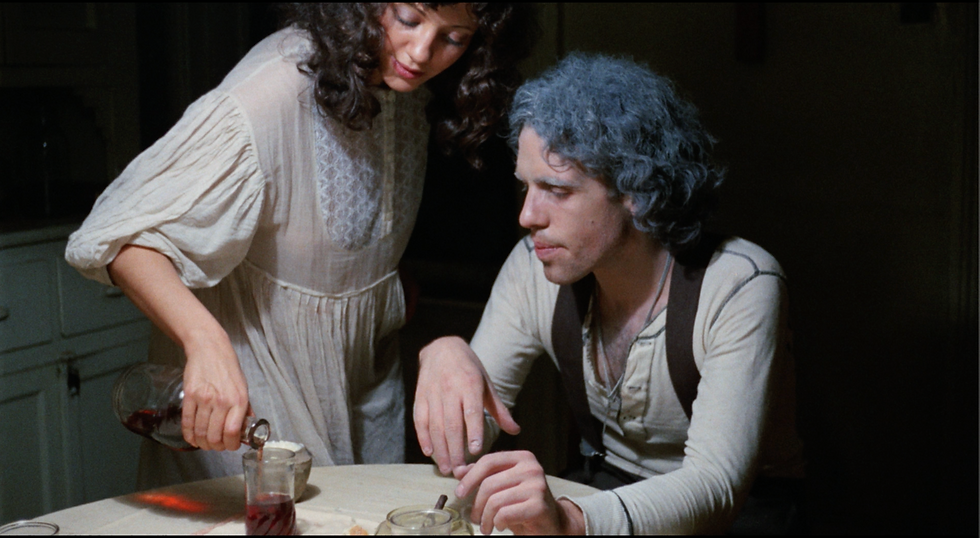
Gypsy narrates as the sisters conspire to get their father incredibly drunk one night and use his body for their own sexual ends. The scene is a rare, complete subversion of the incest trope that appears in pornography time and time again. Instead, there is no explicit corruption by the power held within a patriarchal family dynamic; instead, an illustration of the lengths true desire will go to satisfy itself: the drive of Eros lying completely outside of the doctrine of morality that civilisation insists upon to ensure participation in and continuation of its future.
After getting their father so intoxicated one night that he falls asleep at the dinner table, Pauline's grandmother and her sisters drag him into his bed, pull down his trousers, and each take turns riding his erect penis. Instead of depicting father-daughter incest as a traumatic event which removes the daughter's sexual agency by

illustrating the societal expectation of children to succumb to the desires of their parents, the girls partake in a collective ritual of coming-of-age discovery which affirms their agency as emerging sexual beings. I'm yet to come across another scene in hardcore that does what this scene does to subvert the incredibly potent taboo of incest
to give sexual agency not just to women, but especially young women, in a way that isn't exploitative under the indoctrination of patriarchy. Perhaps the most comedic scene as we get to see Ferrara act as an old man with lots of talcum powder whitening his hair. Noting here that he inserts himself into his own film to surrender his fictionalised body to a kinda mythological origin story of intense sexual discovery that starts with Pauline's grandmother, whom Gypsy says 'has the soul of her grandmother'. Another invocation of the kind of incomprehensible magic that bubbles on the edge of true depictions of sexuality something the genre rarely illudes too in it's quest for maximum visibility of sexual organs.
outro
I've previously called 9 Lives of a Wet Pussy Ferrara's 'Delta of Venus', referring to an incredible collection of literary pornography written by Anais Nin that similarly deploys a dreamlike structure that holds stories within stories of women as autonomous, sensual beings within a compelling textural narrative where their desire takes centre stage without moral repercussions or lessons to be learnt. I find woven between the fading vignettes, a realistic depiction of the heightened kind of relationships that occur between women whose intense desires remain to be explored as extensively as male and/or heterosexual dynamics in visual culture. A film that is way ahead of its time and remains a film worth watching and discussing as part of the lesbian/queer canon.
It's an incredible shame that, whilst Ferrara has not exactly disowned this film, it seems to avoid inclusion alongside collections and retrospectives of his filmography. I insist through this article that it is impossible to dismiss this film as just a way for Ferrara to begin his remarkable career as a filmmaker, as it lays the groundwork for the themes he explores through the variety of genres he traverses, some of which: the collapse of fantasy and reality through the experience of desire, repression, redemption etc etc.
9 Lives is up there as one of his most accomplished films. One of the most compelling, sensual, and truly erotic in the Batallian sense - of the genre. Remarkably, he achieved that with his first attempt at filmmaking and a moderate budget. Goes without saying that all film relies on collaboration, with every part to play contributing to a finished product, and so 9 Lives also presents a glimpse of the hidden talent in underground art scenes that have existed across time and space.
All great works of cinema unearth something valuable to each present moment; here, it is not just the incredible talent, but importantly, the new potential for sensuality being articulated in a new age of Western visual pornography.

Pauline is a fascinatingly singular character in film history and remains elusive through the periphery of Gypsy's obsessive longing that frames 9 Lives of a Wet Pussy. She cannot be owned: she's the ultimate bataillean subject: no solid identity, no memory, but instead an active embodiment of the eternal now in her expanding quest of excess and liberation from the material body, which is enforcably encoded, held hostage by societal expectation. Here, fantasy is real and unshakable and demands being acted upon to truly live and breathe and participate in this sublime thing we call life.
-
Thank you Vinegar Syndrome, for the incredible uncut restoration of this masterpiece of erotic cinema.
Screened as part of Paraphysis Cinema's 'The Summer of Skin' Programme in June 2025.
-
[Decent copy available here: https://www.erogarga.com/nine-lives-of-a-wet-pussy-1976-abel-ferrara/]


Comments