

Hardcore Redemption: WATER POWER (1977)

Updated: Jun 26, 2025
Hardcore Redemption is a new article exploring how to appreciate hardcore films as more than just shit to get off too. Pornography is a cultural object that comments on the nature of sexual fantasy and its function in everyday life and should be [where appropriate] interpreted as commentaries on the ever-morphing shadow of human sexuality. Here I shall attempt to redeem my favourite titles of the genre.
INTRO
The neon lights of 42nd Street glare from behind an unassuming, mop-headed figure in a black roll-neck and denim jacket. The most notoriously vibrant, sleazy street of New York City blinkering behind this casual stroll, a stroll laden with curiosity for the array of explicit offerings. I am faced with a familiar image; a man, alienated and alone, wading amongst the decay of a dying city. A city with such gutted infrastructure and mass poverty and unemployment, known for its crime, filth, and sleaze so much so, that it takes on a life of its own; becomes a character, finds itself on-screen as the psychic stage for unveiling the darker side of man’s persuasions.
Shaun Costello’s Water Power is part of the canon of a despairing and disenfranchised image of urban masculinity in American films of the 70s. Especially in its way of proposing that dense urban living areas, particularly that of NYC, manifest as its own type of psychosexual madness like a Ballardian prophecy...
NYC IN the 70s
It’s 1975: the City of New York is a hair’s breadth from bankruptcy. After an appalling mishandling of public funds and a rising figure of unemployment; tens of thousands of middle-class white families leave the city, taking with them their tax revenue and business. The remaining working class continue to witness a rapid decline in the quality of life through a collapse of public services. A knock-on effect, sees a rise in criminalised activity such as petty crime and sex work. Throughout the decade, NYC creates a notorious image of itself on the big screen with filthy streets unsafe to walk down—stories of a Times Square full of drug pushers, pimps and thieves that wouldn’t think twice about it.

Meanwhile, this is the decade the New Hollywood movement revitalised American cinema. Narratives reckoning with a masculinity confronting itself post-sexual liberation of the 60s. Here, New York City found itself portrayed again and again on screen as a city of disillusionment, madness and alienation (Taxi Driver, Serpico, Mean Streets, Klute, The Warriors etc) when it wasn’t a romantic backdrop for people who poverty doesn’t touch.
Subsequently, 1975 is the year that sees the end of America’s war with Vietnam. By this time, the propaganda machine had failed, and many saw through the farce pushed onto the American public to justify the continuation of an abstract, guerrilla war. I don’t think that up until this point the trauma of the ‘nam vet had started to be processed and purged in popular culture. The memoir of A Rumor of War by Philip Caputo didn’t come out till 1977. Platoon by Oliver Stone, another decade after that.
Shaun Costello even beats Taxi Driver by 3 years in portraying a man afflicted with the trauma of a war veteran in Forced Entry (1973). I see his debut film as a kinda prototype to the more comedic and stylistically refined Water Power.
DETOUR: Forced Entry (1973)
Characterised by shaky hand-held shots, a soundtrack of an unlicensed, extended version of Tubular Bells, employing horror elements of rape + murder: Costello’s first hardcore film solidifies the stylistic choices he’s continued exploring throughout his career.
Forced Entry follows a confused man in a baseball cap [played by Harry Reems of Deep Throat] using his job at a gas station to extract the names and addresses of attractive women he services. This man’s unstable mentality is portrayed through interjecting monochrome war reels from the frontlines of Vietnam. The bustling streets of New York merge with his memories of the busy markets as if overstimulating him right back into the war zone. The filthy streets of New York feel no different to him. Extreme paranoia and social isolation see him stalking the city like he's fighting his surroundings. Every stranger is an enemy.
He tracks down the woman from the opening scene to her apartment, climbs up the fire escape and stands outside the window watching her and her boyfriend fucking. We keep cutting from the sex to his irritated, raging inner monologue while he stands outside holding a gun, trying to bust in. This hardcore scene is really slow and soft and intimate but then the tension is still built by the nameless vet twitching outside the window (a miracle he wasn’t noticed). Scared off by sirens - he returns later, manoeuvring the urban landscape like a jungle.
I will say Harry Reems is great in this. He is one of many on the NYC hardcore scene that is just as good as an actor as he is at fucking. I find it hilarious that this is the one movie he regrets doing. Though I do understand because a large majority of the dialogue he gets is crass and rapey.
‘What do you think you’re some kinda g**k from ‘Nam??”. She pulls away from his penis as he forces it in her mouth, holding a knife to her neck. An uncomfortable misogynistic rant procurs, commanding her to enjoy the rape as if it’s a privilege. The scene is intercut with the faces of Vietnamese ladies, directly implicating the sexual violence of colonialism. Rape is explicitly implicated as a tool of war; how war permanently alters the psyche.
This is how war is brought home by traumatised people.
He slits her throat with her own knife; a visual that communicates a shifting of blame onto her, for thinking she's so much better than everyone else. There is something about class that motivates his aggravation towards these women. Something about these women being slightly more affluent than him, a forgotten war veteran. A woman who is supposed to be beneath him.
In his review of the film, Ed Demko closes with the statement, “‘Forced Entry’ is one of the more important and relevant films to ever come out of that age of pornography. It’s a film that really transcends the time that it was made and might even be more important now than the age it was made.”
It is (as far as I know) the first film about the trauma of ‘Nam and its impact on veterans who are sent back home to live out isolated lives in an alienating metropolis, invisible, suffering from PTSD, homelessness etc. Alas, not even mentioned alongside the Hollywood movies exploring similar themes that Forced Entry precludes, because a popular consensus is that pornographic films have nothing to offer other than ‘degeneracy’.
I see this hardcore horror as a prototype of Costello’s later, more refined effort of Water Power. Arguably, a more watchable film with its parodic approach, but it continues exploring a kind of proto-incel cinema as it is lived in an environment of a filthy, alienating city.
[WATER POWER]

PRODUCTION
It’s 1976: Shaun Costello, already established in the business of hardcore images, arrives at the office of Sid Levine in Star Distributors, the somewhat legitimate pornography distribution wing of the DeCavalcante crime family. The request, stooped in shame: “they need an enema movie.” Who the ominous’ they is… The family? What information on current fetish trends did they have up their sleeve to make some cash?
Wringing their hands clean of this shitty movie from the get-go, Levine on behalf of the family, hands Costello an audio cassette of a ridiculous scene from ‘The Enema Bandit’, an audio of performance clearly based on the attached magazine clippings, detailing a man convicted of forcibly giving enemas to women on the campus of the University of Illinois. Telling him, no one wants anything to do with the picture, just get it made.
What documentation remains of Michael Hubert Kenyon’s crime is in The Illinois Enema Bandit — an upbeat blues tune by Frank Zappa.
The year after, Costello gathers his ‘favourite’ actors:
“Since I would be making this movie without parental supervision, I was free to turn it into a parody of itself. I wrote a ludicrous script, hired my favourite actors; Jamie, Marlene Willoughby, and Rob Everett, and went about shooting what I still think is the funniest movie I ever made. Of course, there was always the chance that Dibi and the boys Downtown would catch on to what I was doing, and I would sleep with the fishes, but I didn’t think so. I had long-before made a friend of living with risk, and with ‘Water Power’ I was willing to go the distance.”
THE MOVIE
Our star is a frequent face in the hardcore scene / Shaun Costello’s filmography: the fantastic Jamie Gillis (Midnight Desires, The Passions of Carol) posing as a young man blind to his own kinky sensibilities that inevitably get spliced open upon a visit to a brothel on 42nd Street, inside which he is offered by the Madame to witness an enema scene requested by one of the clients.
After a timely stroll down Times Square, our lonesome protagonist enters one of the dozens of brothels. A blow job and penetration scene later - with another pornographic icon (my fave try-sexual) Sharon Mitchell - Burt (our eventual Enema Bandit) enquires into the ‘Special Menu’. The Madame leads him down to a window into a room dressed up like an operating theatre for the medical fetishists. Burt watches this yuppie fella dressed up in a doctor’s outfit, engage in a CNC enema scene with a young lady and an assistant nurse.
As the woman squeezes the water out her ass into the bowel, the nurse jerks off the Dr fella whilst he cums into her mouth. Being a voyeur to this scene, Burt simultaneously blows a load in his pants with intercutting close-ups of their ridiculously exaggerated cum faces.
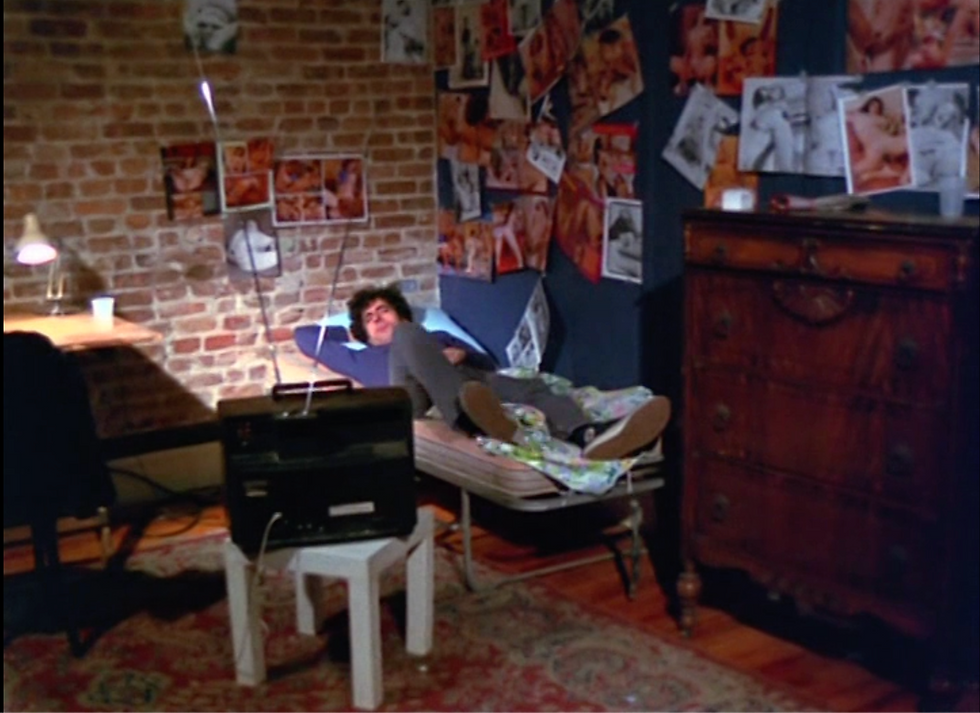
Spooky music plays, as Burt makes his way home under a dark filter of red, signifying some kinda psychic shift in our protagonist. We already know he’s a bit of a pervert from a glimpse into his bedroom which is generously decorated with torn out pages of porno magazines and a telescope in which he stalks the woman who lives in the opposite apartment. It’s like some repressed kink has dislodged the fellas brain. Whilst flicking through his newly purchased enema magazines [called Water & Power], his thoughts return to her, ‘Pure pretty, beautiful stewardess, she doesn’t need any of that. She’s perfect the way she is.’
The emerging psychosexual pathology of Burt seems adamant that the enema is a purifying ritual on women who’re dirty sluts + need ‘cleansing’. Moments later when the stewardess brings home her boyfriend for a make-up fuck, our Enema Bandit goes ballistic. He repremands her for enjoying a cock in her mouth by ranting the obvious, tried rhetoric of the Madonna/Whore complex.
He really despises the sight of her enjoying herself with her boyfriend; “How could you do that? How could you let him touch you like that? You were so much better than the others!”
Burt even has a diary with entries that sound straight from Travis Bickle’s in Taxi Driver. Into which he rants about the uncleanliness of the stewardess and how he’s gonna sort her out, evoking a kinda medieval idea of purity when vowing to clean out her ‘vile humours’.
At this point Burt makes his way across the fire escape from his apartment to outside the stewardesses, breaking in whilst she showers alone, and at gunpoint forces a blow job before giving her an enema in the bath. Again, ranting much like Harry Reems’ character in Forced Entry; about the contamination of these women. Sprawls of misogynistic shit about having sex before being married, in this claustrophobic bathroom, pink walls closing in, Burt looming over her spitting now familiar rants of a self-identified incel. I’m sure you’ve heard of them. Defined by their dedication to upholding the patriarchy that makes them suffer so much in isolation; by blaming women through their justification and undying belief in what is known as the Madonna/Whore complex. It is difficult to meet a heterosexual man who has not developed a variation of this dichotomy. Unfortunately for Burt it seems to manifest into serial rape.
The next scene takes one by surprise, as it’s revealed Burt has had a girlfriend this whole time and hasn’t been in contact with her for over 2 weeks. She turns up at his door, pleading with him to tell her what’s wrong, but he’s distant, trapped in his own head; he shoves her out the apartment.
This begs the question of what she thinks about all the naked women pasted around his bed? If she’s even been inside. Is this the woman in his life he regards as pure, and so he must 'get off' with prostitutes instead?
Until this point, he seems like a bit of a loner, isolated in a one-man apartment right in the centre of a bustling New York City. He deliberately hasn’t seen his girlfriend for a reason that doesn’t explicitly reveal itself, but can only be about keeping two parts of his life separate. This is where he differentiates from the protagonists in Forced Entry, Taxi Driver etc, who struggle to maintain close relationships with women.
Though it's not too explicit, perhaps the cause of this alienation and unravelling of the psyche into an obsession with enemas, can obe a result of living near Times Square; the endless block of porno theatres and peep shows stealing the eyes of passers-by. A world in which the director and actors of this film were very much a part of in real life.
“November 3rd.
I never felt quite so clean as I do now. I decided to equip myself, so I went to several stores and got myself more enema equipment. If this is to be my life’s work then I must be prepared for any eventuality that might arise. It’s true that I have to clean these dirty whores out. But I also have to do it right. I can’t just stick tubes up their asses and hope for the best. No. an enema’s more meaningful than that. I see a whore and I clean her out. I know it sounds simple. But giving an enema is an important responsibility. After all, it’s my job.”
The film goes on with two more assaults/enema scenes, one with two sisters in school uniforms, cause Costello loves a lesbian scene (homage to a similar scene in Forced Entry), and one encountering an undercover cop trying to catch him for his enema crimes. Each staging of the enemas gets more elaborate as they go on, in true psychopathic fashion. I won’t spoil the whole thing for yous. If you're curious, it can be found on Internet Archive. Thank you, whoever uploaded this.

MASCULINITY IN CRISIS / PROTO-INCEL CINEMA
A New Hollywood emerges, defined by authorial directors such as Scorsese and Coppola, Cassevettes and De Palma etc. Through this renaissance, new archetypes of masculinity are being moulded in the contemporary visual language, and by the 70s, feature an abundance of antagonistic protagonists. Our broken, post-modern anti-heroes reveal the shifting understanding of hegemonic masculinity.

What I find interesting about this decade, was the depictions of urban masculinity in films that’re impossible to separate from their environment New York City: The French Connection (1971), Serpico (1973), Saturday Night Fever (1977), The Warriors (1979) but most notably and similarly to Water Power — Taxi Driver (1976). Themes of working-class disenfranchisement in the latter 3, really capture the turmoil the city was going through at that moment. Even the stalker in Klute (1971), Michael in The Godfather (1973), later protagonists in The Driller Killer (1979), Cruising (1980) - each explore a masculinity that is in direct relation to the flame in which it was forged. In this case, New York City itself. The archetype of the metropolis.
Each suggests, in the variation of their themes, a masculinity in crisis after the sexual liberation movements of the swinging 60s and Second Wave feminism. An unconscious retaliation to women’s newfound economic freedom and the separation of sex from marriage/requirement. Something we’re seeing repeated today, after Fourth Wave feminism, with a rise of ‘Incel’ culture that blames the woman, the whore, for his alienation within a capitalist system that rewards the beautiful and narcissistic. Masculinity is in crisis because of the disenfranchisement of poverty, the breakdown of traditional gender roles, and in this case, the paranoia of corrupt government conspiracies. The decade moulded a masculinity that was dealing with the unfathomable trauma of war - all within a hostile urban environment that alienates and spits them out as if they were nothing. Characters like Burt, Travis, and the gas attendant are defined by how heavily misogyny plays into their attempts to gain back control.
The ambiguity around the masculine shadow comes to light within this particular era of American filmmaking. A shadow exacerbated by living in a struggling, poverty-stricken urban metropolis. It reminds me of the dystopian landscapes of British science-fiction author J.G Ballard, and how they directly speak to the fragmentation of post-modern subjectivities. Ballard, like no other contemporary writer, lamented the physical landscape as a self-perpetuating symptom of insanity through dystopian narrative. His oeuvre is a repeated examination into the transformation our built surroundings have on us, and cannot help but seep into our inner worlds.
Water Power, amongst its toilet humour, explores ‘hegemonic masculinity’ (coined by R.W Connell). A phrase that attempts to show how gender relations in a patriarchal society are unquestionably normalised. Masculinity defines itself in opposition to Woman/Nature, and in this case, the urban environment, to subjugate it. To dominate it. Maintaining hierarchy.
As a man shaped by the temptations of his environment, the seediest corners of Times Square, Burt’s character hinges on the link between environment and disintegrating mental state. The city, within its suffocating concrete, holds the potential to corrupt the spirit because of the collation of vices, criminality, and austerity that perpetuate each other. As the masculine struggles with frustration in his disenfranchised position, he seeks neurotically to gain control through some exertion of physical, often patriarchal violence. A repeated theme of proto-incel cinema.
REDEMPTION
Hardcore; arguably the basest form of pornography, the way it makes everything so Visible in the search for truth in the gestulating movements of bodies.
The medium of hardcore, particularly, accesses the realms of psychosexuality in a direct, money-shot kind of way. It shows us what is so often only alluded too by cinematic tricks, concealed in shadows and metaphor like the abandoned alleyways of the noir genre.
In Hardcore: Power, Pleasure and the “Frenzy of the Visible”, Linda Williams talks about Beverly Brown’s idea ‘[that] pornography reveals current regimes of sexual relationships as a “coincidence of sexual phantasy, genre, culture in an erotic organisation of visibility.”’
Being anti-pornography, or dismissive of its representations, implies a belief that there is a separate ‘truth’ of sexuality that lies outside of language and culture.
This is simply not the case.
The pornographic cannot avoid being political, because it explores the dynamics of power scorched onto our psyches from actively participating in the world and it's structures. Here, we all succumb to the flow of power.
‘The idea that pleasures of the body do not exist in immutable opposition to a controlling and repressive power, but instead are produced within configurations of power that put those pleasures to particular use’ - is a Foucauldian thought about power producing (active) rather than repressing (passive) our sexualities. That is to say, power produces fantasy. Therefore, our sexuality is constantly reconfiguring itself to seek pleasure in the face of a domineering power. The hardcore genre is just one of many forms of the Foucauldian ‘knowledge-pleasure’ (pleasure of knowing pleasure).
With an abundance of contemporary discourse on unnecessary sex scenes in tv and film, I believe it is as important as ever to make legible the necessity for the visibility of sex (all forms from socially accepted to devious) in art, and specifically, the discarded, intellectual and literary genre of Pornography. As a society we are so averse to talking about the impact proliferate internet porn has on our culture because we’d rather pretend it does not exist; that we don’t all have sexuality that has been explicitly shaped by these commodified, industrialised, visual representations of sex.
We refuse to teach young people how to approach questions of power and pleasure, the function and importance of sexual fantasy and how to read pornography as media. And we are suffering because of it.
Pornography makes visible what should only be illuded too by subtextual readings; the immediacy of sex and the prevalence of sexual violence in our culture. We parrot that pornography normalises and perpetuates misogynistic violence, but the images of misogynistic violence in pornography were already in the world before the invention of the camera magnified it. Pornography is so much more than an irredeemably misogynistic medium made only for the male gaze. I will continue to prove so with this article :)
Water Power might be true crime pornography: a scuzzy, home invasion enema horror, but it’s not without historical context.
“For better or for worse [pornography is] the imaginative record of man’s sexual will.”
Peter Michelson (The Aesthetics of Pornography)

reading list:
The Worst Decade in the History of New York https://www.youtube.com/watch?v=dSynYj5eNBM
Review https://houseofselfindulgence.blogspot.com/2011/09/waterpower-shaun-costello-1977.html
Shaun Costello's Blog https://shauncostello.com/2010/10/11/waterpower-3/
Inverting Crusoe in the Anthropocene: Hegemonic Masculinity in J. G. Ballard’s The Drowned World
Fritz Lang's Metropolis https://www.tboake.com/dystopia/patterson/social_dystopia_1.html


Comments